
What Should I Do If My Website Isn’t Generating Leads in Bellingham?
If your Bellingham website is getting little traffic—or attracting visitors who never call, schedule, or request an estimate—the first step is finding where the customer journey is breaking down.

If your website is not generating leads, do not immediately spend more money on advertising or assume you need an entirely new website. First determine whether the problem is local visibility, traffic quality, unclear messaging, missing trust, mobile usability, or a difficult contact process.
Most underperforming websites have a breakdown in one or more of these areas. Once you know where the problem is, you can make targeted improvements instead of randomly changing headlines, colors, buttons, and pages and hoping something finally works.
And friend, hope is lovely. It is not a conversion strategy.
Key Takeaways
- A lack of leads does not always mean you need more website traffic.
- If your visitors are outside your service area, higher traffic numbers may not help your Bellingham business.
- Local visitors need to understand what you do, why they should trust you, and how to contact you within seconds.
- Your website and Google Business Profile should communicate the same services, location, and business information.
- Not every underperforming website needs a complete redesign.
- One of our clients experienced lower overall website traffic but a fivefold increase in new customers after we improved traffic quality and the website’s conversion experience.
Why Isn’t My Website Generating Leads in Bellingham?
A Bellingham website usually fails to generate leads for one of two broad reasons: the right people are not reaching the website, or the website is not convincing those people to take action.
That gives us two places to investigate:
- Visibility: Can potential local customers find the business?
- Conversion: Once they arrive, does the website help them confidently take the next step?
Use the table below as a starting point.
| What You Are Seeing | What It May Mean | What to Review First |
|---|---|---|
| Very little website traffic | Local customers cannot find you | Search visibility, service pages, local SEO and Google Business Profile |
| Traffic from outside Bellingham or Whatcom County | You are attracting the wrong audience | Visitor locations, search terms and content topics |
| Homepage visits but few service-page views | Your message or navigation may be unclear | Homepage headline, menu and service descriptions |
| Service-page visits but no calls or forms | Visitors may lack trust or direction | Reviews, proof, calls to action and contact process |
| Mobile visitors leave more often | The mobile experience may be frustrating | Mobile layout, speed, buttons, forms and click-to-call features |
| Google Business Profile clicks but few leads | The profile and landing page may not match | Services, location information, messaging and linked website page |
| Leads cannot be accurately measured | Your tracking may be incomplete | Form tracking, phone-call tracking and analytics setup |
This is why a website audit should start with evidence, not assumptions.
Before changing your website, it also helps to understand the five things your website should do to attract visitors, build trust and turn more of those visitors into leads.
If your Bellingham website is not generating leads, start by checking these seven areas:
1. Can Local Bellingham Customers Find Your Website?
If your website receives very little relevant traffic, the first problem may be visibility. Local customers cannot contact a business they never find.
Your website should clearly communicate:
- What services you offer
- Who those services are for
- That you serve Bellingham or the appropriate Whatcom County communities
- Why someone should choose your business
- How to contact you
That information should appear naturally in your page titles, headings, service pages, website copy, internal links and business information.
For example, a Bellingham HVAC company should not rely on one general services page that briefly lists heating repair, air-conditioning installation, heat pumps and maintenance. Important services may need their own useful pages so both customers and search engines can understand what the company offers.
This does not mean squeezing “Bellingham” into every other sentence until the copy sounds like it was written by a robot with a location obsession. It means giving people and search engines clear, honest information about what you do and where you do it.
A strong local SEO for small businesses strategy helps connect your services with the local customers who are actively searching for them.
2. Are You Attracting the Right Website Traffic?
More website traffic will not necessarily produce more leads. Your traffic needs to come from people who are reasonably likely to need your services and fall within the area you serve.
Imagine that you own a Bellingham heating company and one of your articles attracts thousands of visitors searching for do-it-yourself furnace instructions. Those visitors may increase your traffic total, but many are looking for instructions—not a local company to hire.
There is also an important difference between someone searching:
and someone searching:
Both searches may relate to furnaces, but the second visitor is much closer to contacting a local service provider.
Check which locations, searches and pages are producing your traffic. If most visitors live outside your service area or arrive for topics unrelated to your paid services, the website may not need more traffic. It may need a better traffic strategy.
3. Can Visitors Understand What You Do Within Seconds?
A visitor should be able to identify what you offer, who you help, where you work and what to do next without scrolling through half the homepage.
Vague headlines are one of the most common problems we see.
A headline such as:
Could describe a web designer, wedding planner, photographer, contractor, interior designer or business coach. It sounds pleasant, but it does not help a potential customer determine whether they have reached the right business.
A clearer headline would be:
The second version tells the visitor:
- What the business provides
- Where it provides it
- Who it serves
- What result the service is designed to support
Your homepage does not need to tell your entire story in five seconds. It does need to give people a reason to stay and learn more.
Confused visitors rarely become customers. They become someone else’s website traffic.
4. Does Your Website Give People Enough Reason to Trust You?
If people visit your website but do not contact you, they may not feel confident enough to choose your business.
Potential customers are quietly asking:
- Is this a legitimate business?
- Do they understand my problem?
- Have they helped people like me?
- Do they have experience?
- What will it be like to work with them?
- Can I trust them to do what they promise?
Your website should answer those questions with specific proof.
Helpful trust signals may include:
- Customer reviews
- Local projects
- Case studies
- Before-and-after examples
- Photos of your real team
- Professional credentials
- Years of experience
- Awards or community involvement
- A clearly explained process
- Answers to common customer questions
- Measurable client results
Local proof is especially helpful for a Bellingham business. Showing projects, clients or experience connected to Bellingham, Ferndale, Lynden, Blaine or the surrounding Whatcom County area helps demonstrate that your local presence is real.
Statements such as “We offer exceptional service” are not proof. Nearly every competitor says some version of that.
Show people what makes your service exceptional. Better yet, let your customers and results show them.
5. Is it Obvious How Someone Should Contact You?
A website visitor should never have to hunt for the next step.
Your primary call to action should appear near the top of the page, at natural decision points throughout the content and again near the bottom.
Depending on your business, that call to action might be:
- Request an Estimate
- Schedule a Consultation
- Book an Appointment
- Call Our Bellingham Office
- Check Project Availability
- Request a Free Visibility Review
Avoid making every button say “Learn More.” Learn more about what? Where will the button go? What happens after someone clicks it?
Specific calls to action reduce uncertainty.
Your contact process should also be simple. A person asking for an estimate probably does not want to complete a form that feels like a mortgage application. Ask only for the information you genuinely need to begin the conversation.
Then test the process yourself.
Submit the form. Tap the phone number. Check the confirmation message. Make sure the lead reaches the correct inbox.
You would be surprised how many businesses are waiting for leads from a form that quietly stopped working three months ago. Not exactly the growth strategy we were hoping for.
6. Does Your Website Work Well on a Phone?
A mobile visitor should be able to understand your services, view your proof and contact your business without pinching, zooming or muttering unkind things about your website.
Review your mobile site for:
- Text that is easy to read
- Buttons that are easy to tap
- A working mobile menu
- Clickable phone numbers
- Forms that are simple to complete
- Images that load efficiently
- Important information near the top
- Layouts that remain stable while loading
- Pop-ups that do not cover the entire screen
Do not review the mobile experience only from your office computer. Open the website on several actual phones and complete the same steps a customer would take.
Mobile usability is one of the most important parts of effective web design in Bellingham, especially when local customers are searching from their phones and want to call, schedule or request an estimate quickly.
7. Are Your Website and Google Business Profile Telling the Same Story?
Your website and Google Business Profile should reinforce the same information about your business.
Compare the two and check whether they consistently show:
- Your business name
- Primary services
- Service areas
- Phone number
- Business hours
- Brand positioning
- Contact options
- Important specialties
The website page connected to your Google Business Profile should also make sense for the person clicking it.
For example, a company trying to reach customers looking for web design in Bellingham may benefit from linking its profile to a strong Bellingham web-design page rather than a broad homepage—provided that page accurately represents the company and its local services.
Google recommends keeping Business Profile information complete and accurate so customers and Google can better understand what the business does and where it operates. You can read Google’s tips to improve your local ranking for its official guidance.
Professional Google Business Profile optimization can help ensure your profile, services, website and local business information support the same clear message.
How Can You Tell Where Website Leads Are Being Lost?
You can identify many website problems by reviewing analytics, search information and conversion tracking.
We typically look at questions such as:
- Which pages receive the most visits?
- Where are visitors geographically located?
- Which searches bring people to the website?
- Which pages do local visitors enter through?
- Do visitors continue to important service pages?
- Which buttons are being clicked?
- Are forms being completed?
- Are phone calls being tracked?
- Do mobile visitors behave differently?
- Which traffic sources produce actual leads?
The goal is not to collect a giant pile of reports that no one understands. The goal is to connect website activity with real business results.
A traffic increase is nice.
A traffic increase that produces calls, appointments, estimates or customers is much nicer.
Real-Life Example: Less Traffic, Five Times More Customers
One of our Bellingham-area clients was already receiving a healthy amount of website traffic. At first glance, that looked like good news.
But when we reviewed the data, we discovered that much of the traffic was coming from people outside the company’s service area. Those visitors were reaching the website and leaving without calling, scheduling or becoming customers.
The company did not simply need more visitors. It needed the right local visitors and a website experience that gave those visitors a compelling reason to take action.
We redesigned the website with:
- Clearer service messaging
- Stronger calls to action
- Better local content
- More visible trust signals
- A simpler conversion path
- A stronger focus on qualified customers
Within fewer than 90 days, overall website traffic decreased—but the number of new customers increased fivefold.
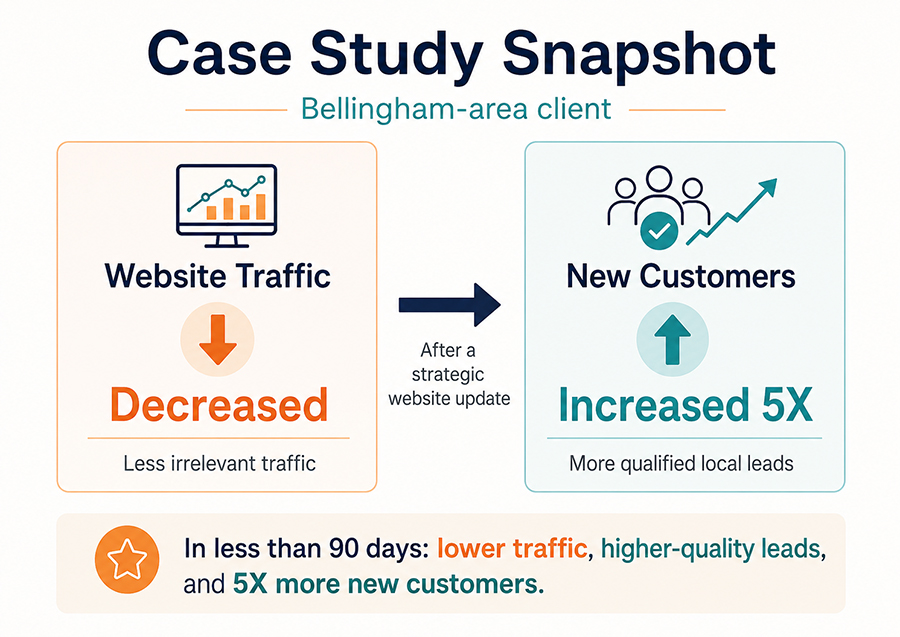
This result reflects one client’s experience and is not a guarantee or universal benchmark. But it demonstrates an important point: a lower number of qualified visitors can be far more valuable than a large number of people who will never become customers.
The goal is not traffic for traffic’s sake. The goal is business growth.
Does Your Website Need Improvements or a Complete Redesign?
Not every website that struggles to generate leads needs to be replaced.
Targeted improvements may be enough when:
- The website works properly on mobile devices
- The design still reflects the business
- Pages can be edited easily
- The navigation is reasonably clear
- The problem is limited to messaging, content or calls to action
- Lead tracking can be added
- Important service pages can be created within the current structure
A full redesign may make more sense when:
- The website is difficult to use on a phone
- The structure does not support your current services
- Important pages are missing
- The design no longer reflects the quality of your business
- The site is slow, unstable or difficult to update
- Navigation is confusing
- Tracking cannot be set up properly
- The site was built without a local SEO or conversion strategy
- Several major problems need to be corrected at once
The age of the website alone should not determine the answer. The decision should be based on its performance, structure, usability and ability to support your current business goals.
For a broader explanation of what a strategic Bellingham website should include, read our complete guide to building a website that attracts local customers and supports business growth.
What Should You Fix First?
Begin with the part of the customer journey showing the clearest breakdown.
–If hardly anyone visits the website
Review local search visibility, service pages, Google Business Profile information and the searches your website targets.
–If the traffic is not local
Review visitor locations, search terms and content topics. Refocus your website around services that local customers are prepared to hire you for.
–If local visitors arrive but quickly leave
Clarify the homepage headline, improve navigation and make important service information easier to find.
–If visitors view services but do not contact you
Strengthen proof, answer common objections, improve calls to action and simplify the contact process.
–If mobile visitors perform poorly
Fix the mobile layout, buttons, menus, forms, speed and click-to-call experience.
–If you do not know what visitors are doing
Set up accurate analytics, form tracking and phone-call tracking before making major decisions.
Fix the most obvious blockage first, measure the result and then move to the next one.
Your Website Should Help Bellingham Customers Choose You
A lead-generating website has four main jobs:
- Help the right people find your business.
- Clearly explain how you can help them.
- Give them enough proof to trust you.
- Make taking the next step easy.
When one of those jobs is not being done, leads can quietly disappear.
At Your Marketing BFF, we look at the complete picture: your website, search visibility, local traffic, messaging, customer behavior, Google Business Profile and conversion process.
We do not begin by assuming you need more traffic or a brand-new website.
We begin by identifying what is not working.
Is Your Website Quietly Losing Bellingham Customers?
Let’s find out where the opportunities are being missed.
Schedule a Free Local Visibility Review with Your Marketing BFF. We will examine how customers find your business, what happens after they reach your website and which improvements could help turn more local searches into calls, inquiries and customers.
– FREQUENTLY ASKED QUESTIONS –
